Back to the type library 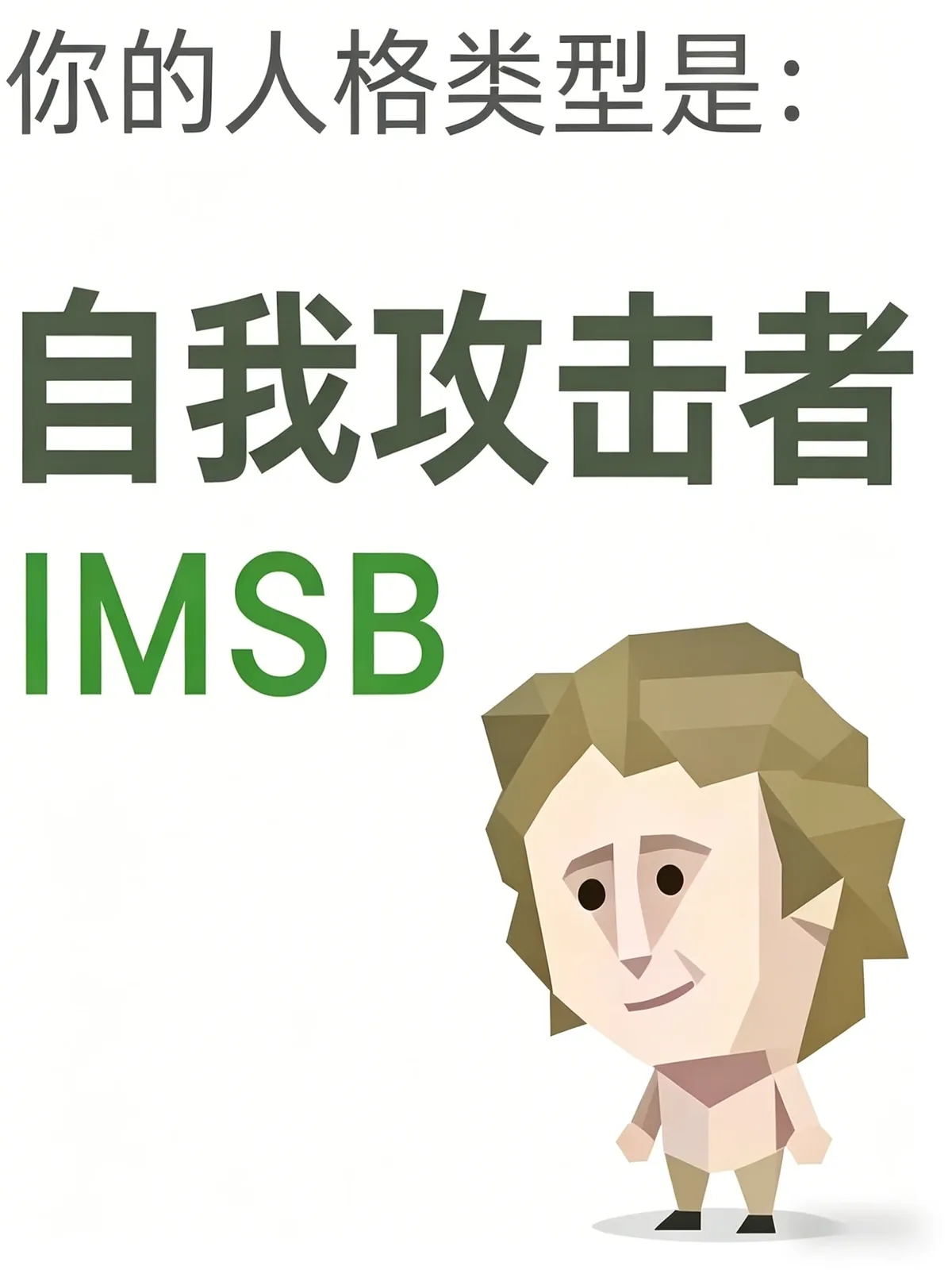
Disaster Brain
Seriously? Am I really that stupid?
Congratulations. You have stepped outside normal humanity and into the once-in-a-million-years IMSB personality. Inside your brain live two immortal warriors locked in constant battle: one screams 'Just go for it!' and the other screams 'I am such an idiot!' When IMSB meets someone they like, the first voice says go ask for their contact, go invite them out, say your feelings loudly. The second voice instantly replies, why would they ever like you back, you are only going to embarrass yourself. The result? You watch them walk away, then pull out your phone and search 'how to overcome social anxiety.' IMSB is not truly stupid. Your inner drama is simply longer than the full Marvel cinematic universe.
Profile structure
How to read this profile
This page shows the stable shape of the profile across five models and 15 dimensions, so readers can understand its core temperament and behavioral emphasis.
Result logic
Standard profiles come from the fixed profile library. The system turns the overall signal into a 15-dimension shape, then matches that structure against the library.
Five-model view
The profile is read through five structural layers: self, emotion, attitude, action drive, and social behavior.
15-dimension shape
Each dimension carries a distinct level profile, and together they form the overall personality contour.
Special-outcome priority
Special outcomes do not sit inside the standard library. They override or catch results through separate rules.
15 Core dimensions
The 15 dimensions below are grouped into five models to show the profile's more stable psychological structure and behavioral center of gravity.
Self model
3 Self model
S1 Self-esteem & confidence
You hit yourself harder than anyone else does. Even praise needs to pass an authenticity check first.
Self model
S2 Self-clarity
Your inner channel is full of static. 'Who am I?' keeps buffering in a loop.
Self model
S3 Core values
Part of you wants to strive, and part of you wants to lie down. Your value system holds frequent internal meetings.
Emotion model
3 Emotion model
E1 Attachment security
Your relationship alarm system is hyper-sensitive. Even one unread message can trigger an imagined finale.
Emotion model
E2 Emotional investment
You can invest, but you still keep a backup plan rather than going all in.
Emotion model
E3 Boundaries & dependence
You want some closeness and some independence. Your attachment style is adjustable.
Attitude model
3 Attitude model
A1 Worldview tilt
You view the world through a defensive filter: doubt first, approach later.
Attitude model
A2 Rules & flexibility
If a rule can be bent, you will probably bend it. Comfort and freedom usually come first.
Attitude model
A3 Sense of meaning
Your sense of meaning runs low. Many things can feel like empty ceremony.
Action drive model
3 Action drive model
Ac1 Motivation
Your first instinct is to avoid disaster. Risk management wakes up before ambition does.
Action drive model
Ac2 Decision style
Your mind tends to take a few extra loops before making a call. Internal meetings often run overtime.
Action drive model
Ac3 Execution mode
Your execution has a deep emotional bond with deadlines. The later it gets, the more awake you become.
Social model
3 Social model
So1 Social initiative
If someone comes to you, you respond; if no one does, you do not force it. Social flexibility is moderate.
Social model
So2 Interpersonal boundaries
In relationships, you want closeness and blending. Once someone is trusted, they move into the inner circle fast.
Social model
So3 Expression & authenticity
You read the room. Truth and social polish each get a share.